
In revenue operations, demand generation, customer success, and business development, how often are cost decisions central to your work? Not beyond your own budget, right?
Ironically, company-wide cost decisions shape all growth strategies.
Gaps Rob Growth Potential
The recipe for success is simple:
Say what customers get and give exactly that (initially and ongoing).
— Marketing plan thoroughly defining this: customers’ expectations.
— Operations plan proactively delivering it: customers’ realities.
— Aim for zero gaps (1-to-1 ratio).
Zero gaps increase budget available for:
— New product development, more robust product launches, market expansion.
— Marketing, Sales, partnerships, acquisitions, hiring, etc.

Costs spiral when gaps exist:
— Self-service and Support.
— Remedies, returns, refunds, and escalations.
— Loyalty, NPS, CRM, Customer Success, etc. make up for gaps.
— The above are necessary to avoid negative word-of-mouth, churn, and lawsuits.
— Opportunity costs and budget for time spent in emails, meetings, and tasks to manage these.
— Some customers affected by gaps bypass the above and churn.
Negative word-of-mouth causes doubts in the market.
— This dilutes Marketing messages and lengthens your Sales cycle.
— This causes higher cost of acquisition and lower sales velocity.
Extra Marketing and Sales budget is needed to make up for all the above.
— Less talent for growth: engineers, etc. tied-up with trouble-shooting and rework.
— Stress reduces everyone’s creativity, including suppliers’ value creation.
Less budget available for growth:
— Constraints on hiring, salary increases, project/development spending, and profit sharing.
Gaps mean customers, employees, partners, suppliers, investors, communities, and economies are robbed of potential growth.
Cost decisions ARE what customers and investors experience.
3 Drivers of Growth
Rethink costs as 3 buckets:
1) Delivering your value proposition.
2) Customers’ changes.
3) Preventable issues.

Good and bad cost decisions affect:
A) Relationship strength (NPS, etc.)
Anything that bothers customers costs you: less trust, goodwill, tolerance, resilience, and engagement. Whatever you do in customers’ favor has the reverse effect for the positive. But, when you’re recovering from what bothered customers, the positives are less potent.
B) Relationship duration (NRR, etc.)
Relationship strength is a key factor for a customer sticking with you and expanding engagement and purchases with you.
C) Revenue (market share, etc.)
Retained customers are a key determinant of your market share and revenue growth.
D) Lifetime value (earnings per share, etc.)
Profit is what investors gain, and revenue growth at high costs implies poor management. Accordingly, wisest cost decisions are in-sync with customer relationship strength in favor of future relationship duration and revenue.
This hierarchy is both sequential as shown above and exponential in financials from level to level (A through D).
1) Value Proposition Delivery: Costs & Growth
All roles company-wide exist to deliver your value proposition.
— Non-customer-facing roles create the products, processes, policies for customers
and for roles who manage customer touchpoints.
— Marketing & Sales communicate value to customers.
— Operations, Service Delivery, & Partners fulfill value for customers.
— Service Recovery rescues value for customers.
— Customers fund everything, including investor returns.
— Investors reinforce everything, according to customer funding.
Your cost decisions ARE what customers and investors experience.

Growth Limitation?
Gaps cause skepticism, myopia, quiet quitting, sloppy handoffs.
These gaps cause tremendous spiraling costs listed earlier.
Spiraling costs squander precious budget, talent, and opportunities.
Otherwise, you could multiply growth.
Leaders’ #1 priority:
Align mindsets, strategies, and performance standards.
— Get crystal clarity of core-growth customers’ aims.
— Get everyone in-sync to prevent gaps and creatively add value to customers’ aims.
— Reward teamwork in right-the-first-time performance (prevention of CX issues).
This results in (a) highest growth budget, (b) lowest cost to run your business, (c) highest relationship strength (d) with longest duration, and (e) strongest attraction for both existing and new customers (and employees, partners, and investors).

Position your CX Leader as an ally to every role company-wide for customer-focused business.
2) Customers’ Changes: Costs & Growth
Be prepared for the inevitable:
a) External forces on customers (weather, economy, pandemic, theft, etc.).
b) Customers’ life changes (org restructure, move, death, etc.).
c) Changing their mind (exchange, return, etc.).
Your cost decisions here ARE what customers and investors experience.
Growth Limitation?
Gaps cause distrust which reduces retention, recommendations, etc.
Then Marketing and Sales budgets must work harder to make up for this.
Shortsighted Marketing plan and Operations plan rob your potential growth.
Example:
In the early days of Amazon Video, the internet connection was occasionally dropped. Upon review of uptime and Support stats, Jeff Bezos asked: Why do we require customers to call us when we already know our service failed? Instead of hoping a percentage of customers will not request a refund/remedy, they automatically credited customers when the connection was dropped. This stopped the burden on Support and increased customer trust and rebuying: win + win + win for EX + CX + Growth.
Leaders’ #2 priority:
Contingency planning for proactive efficiency and effectiveness in all of these.
— Anticipate a wide array of scenarios. (Good use for AI.)
— Make it easy for (a) customers, (b) employees, and (c) partners.
— Build-in feedback loops and ways to talk to a person.
— Continually add to your scenarios and improve efficiency and effectiveness.
This results in trust, relationship strength, retention, engagement, brand preference, and growth of both revenue and profit.
3) Preventable Issues: Costs & Growth
Value Support for its rich insights toward customer-aligned business.
Value Support for reversing negative word-of-mouth, disengagement, churn, and lawsuits.
— Value customers for believing your value proposition.
— Value customers’ time, patience, opportunity costs, and resilience.
Your cost decisions here ARE what customers and investors experience.
Growth Limitation?
Support is key to avoiding lawsuits, churn, and negative word-of-mouth.
These create doubts that dilute your Marketing messages and lengthen your Sales cycle.

Revise your metrics, policies, reviews, and processes aiming for 1-to-1 ratio.
Leaders’ #3 priority:
Stop recurrence of prevalent issues at the root cause.
— Conduct a 5 Why’s workshop annually with each General Manager’s team.
— Focus bonus compensation and recognition on 5th Why mistake-proofing.
— Use surveys to validate (and course-correct) mistake-proofing.
— Monitor value gained by customers foremost, then value multiplied for you.
This results in freeing-up customers who then engage more with you.
You free-up talent, opportunities, and resources from value-rescuing.
Re-assign them to value-creating, and your growth will soar.

Outer loop is your key to gigantic value via customer experience management.
Conclusion
Rethink costs as 3 buckets that drive growth:
1) Delivering your value proposition — preventing issues maximizes growth.
2) Customers’ changes — opportunities for differentiation and preference.
3) Preventable issues — turn lemons into lemonade: free-up opportunities.
“Right the First Time” from customers’ perspective is vital in all cost decisions, growth endeavors, performance standards, and strategies.
When this is your Board’s, C-Suite’s, and Chief Customer Officer’s focus, you will multiply gains in every growth metric, as shown here:
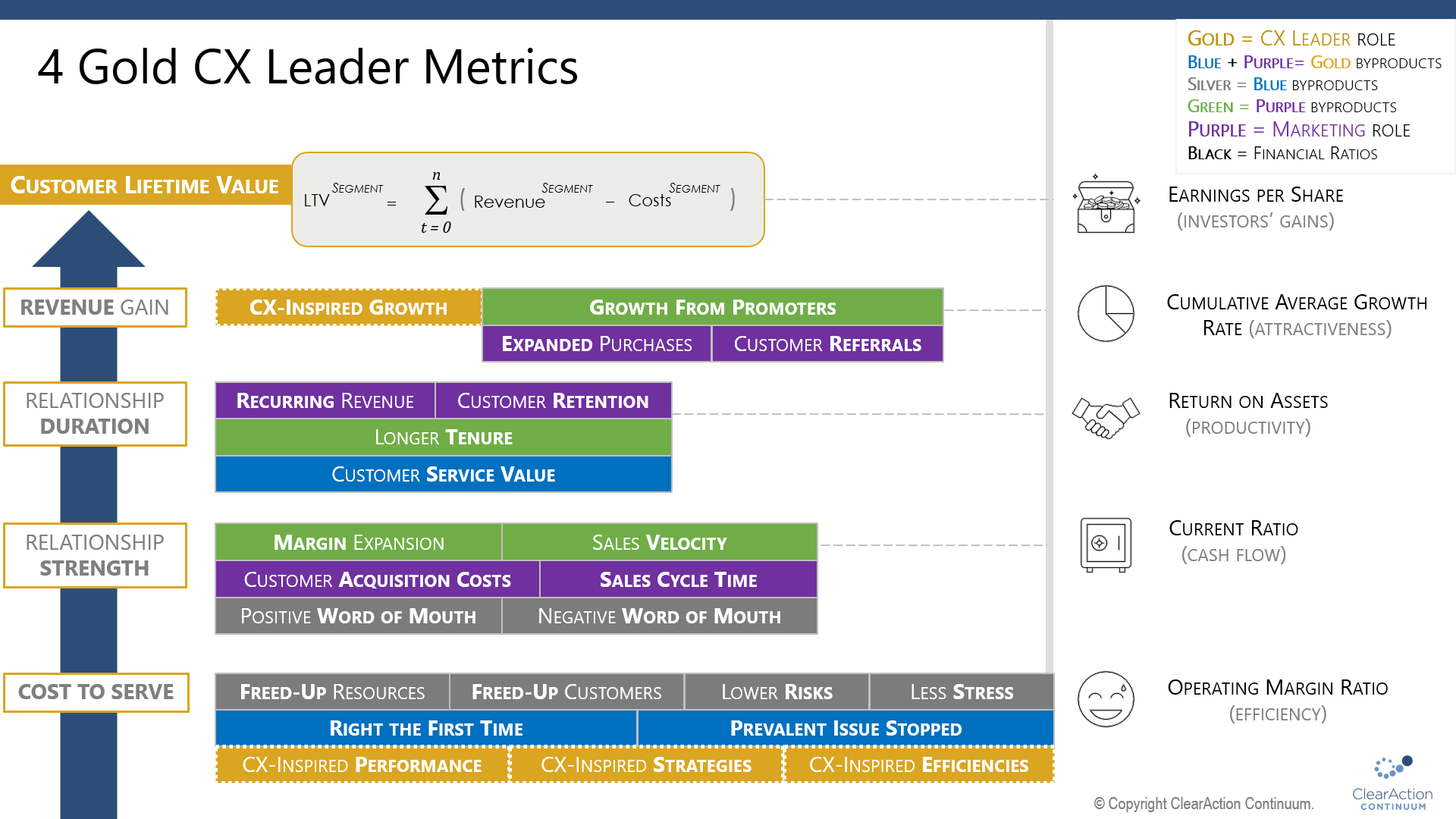
Monitor customer insights use in 4 gold areas to multiply all growth metrics.
Make “1-to-1 ratio” your company-wide priority.
— Avoid gaps to avoid spiraling costs.
— You’ll maximize growth for everyone: customers, employees, partners, suppliers, investors, communities, and economies.
This article was originally published on CustomerThink.com as 3 Surprising Growth Drivers: Re-Thinking Costs.
